

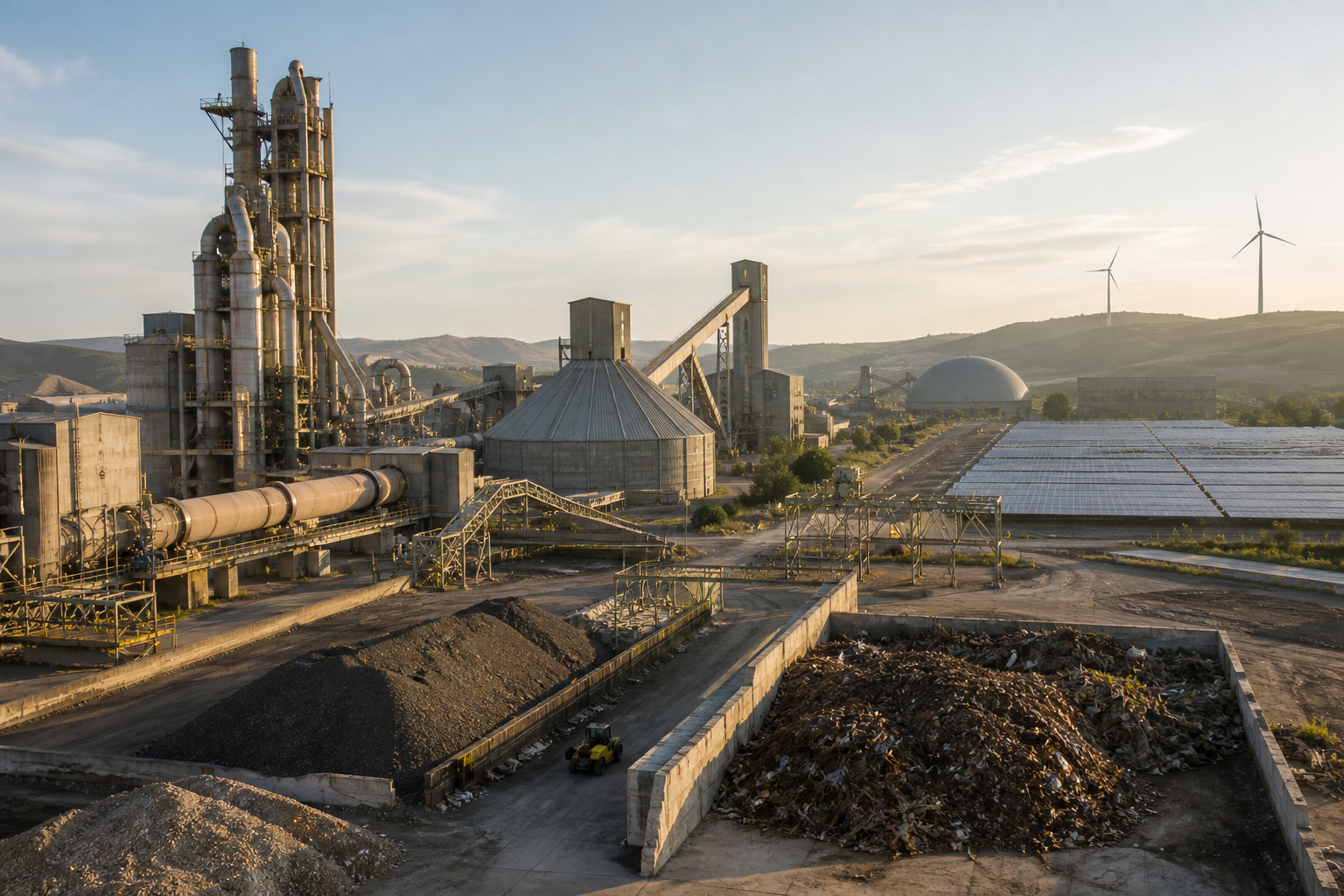
The cement and concrete industry has called for stronger government support to speed up the rollout of technologies aimed at cutting emissions, as a new report sets out progress towards the sector’s 2050 net zero target.
Published by the Global Cement and Concrete Association (GCCA), the report covers projects involving alternative fuels, renewable electricity, lower-carbon concrete, recycled materials and carbon capture. It also identifies policies intended to move these approaches into wider commercial use.
Policy priorities
The GCCA said policy should enable greater use of supplementary materials, establish effective carbon pricing, support carbon capture, utilisation and storage (CCUS) at scale, unlock the co-processing of waste in cement kilns and use low-carbon procurement to create market demand.
It said public procurement rules that favour lower-carbon materials could help create demand for products with a reduced emissions footprint.
“While the industry is making strong progress, key policy priorities are called for to accelerate cement and concrete decarbonisation through enabling greater use of supplementary materials, establishing effective carbon pricing, supporting CCUS at scale, unlocking co-processing of waste in cement kilns, and using low-carbon procurement to create market demand,” the association said.
Reducing clinker emissions
Cement production is emissions-intensive partly because clinker, its main ingredient, is made by heating limestone. This process releases carbon dioxide, meaning emissions reductions will require cleaner energy, changes to production methods and technologies to capture emissions that cannot be avoided.
The GCCA said relevant technologies were already being deployed, but argued that wider collaboration across the supply chain and stronger policy support were needed to expand them more quickly. It presented the measures as part of meeting demand for housing and infrastructure while reducing the sector’s climate impact.
GCCA chief executive Thomas Guillot said: “Five years on from the launch of the GCCA 2050 Net Zero Roadmap, our industry’s commitment remains firm. Across our membership, companies are investing, innovating and acting across every available lever to deliver concrete.
“But our industry cannot do it alone. We need governments and policymakers to match that commitment and help us accelerate our net zero transition.
“With the right policies and partnerships, we can turn ambition into implementation and deliver concrete for a sustainable and resilient world.”
GCCA president and Heidelberg Materials chief executive Dominik von Achten said cement and concrete would remain vital as the global population grew and urbanised.
He added: “Our sector has set out and committed to a credible pathway to produce net zero concrete, and our members are making progress on every lever.
“In addition to climate mitigation, consideration must also be given to climate adaptation and resilience, and as the world’s climate changes our material will be ever more crucial in helping society build resilience.”